To make photons behave like reliable qubits, we can't use "normal" light. Enter the future of single-photon sources.
A bulb, a laser, even an LED: they all produce many photons with messy timing and statistics (bunching). While great for lighting a room, this noise is terrible for a quantum circuit.
Quantum logic hates noise. Photonic quantum computing requires reliable single photons to unlock the magic of entanglement.
Fig 1: Thermal light "bunches" (g²>1), while our source "antibunches" (g²=0).
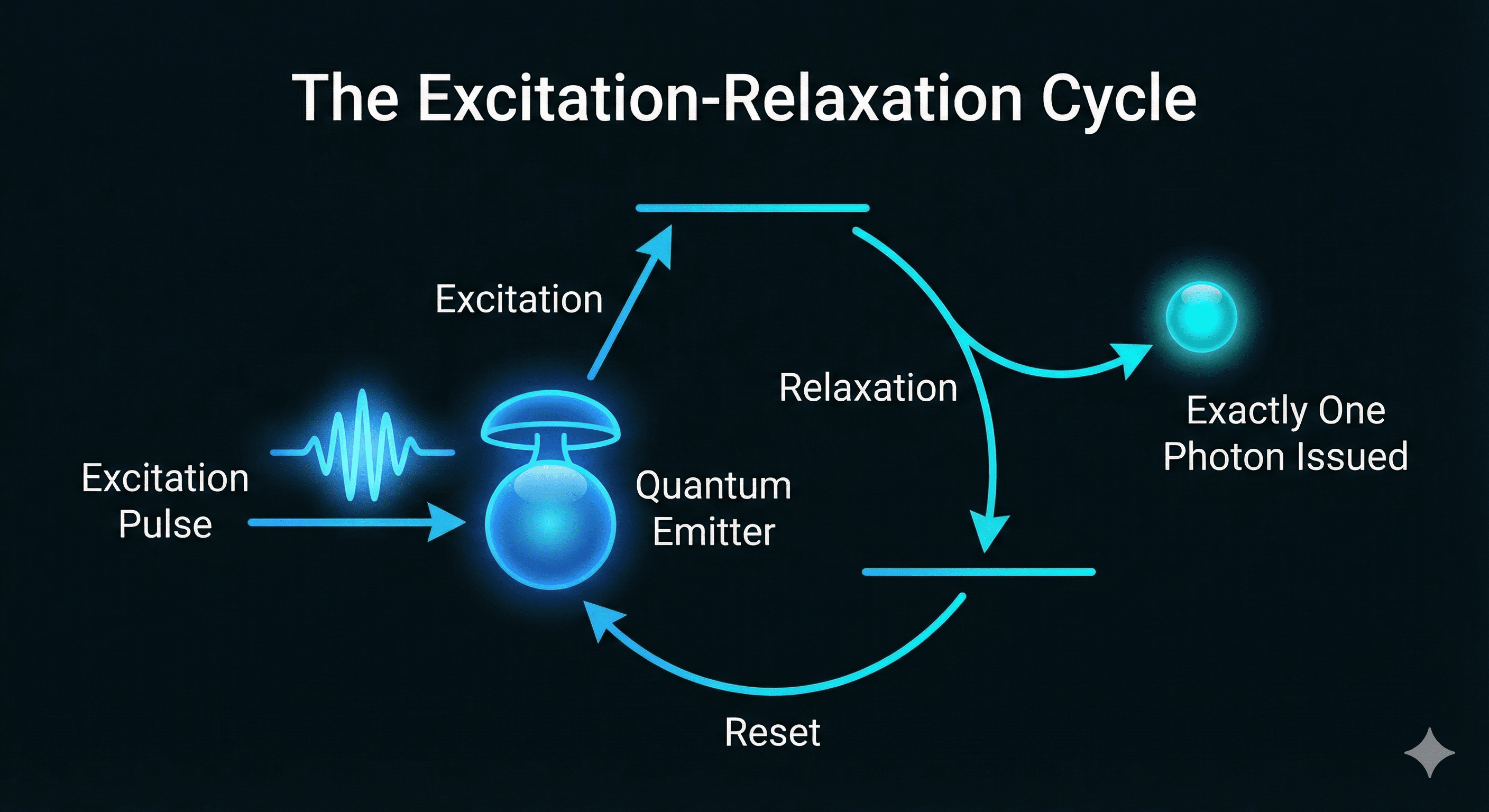
Our single-photon source is the star of the show. It utilizes a precise excitation-relaxation cycle.
You excite the emitter with a pulse, it relaxes, and exactly one photon is released before the system resets. This reliability is crucial for quantum operations.
We use "atom-like" emitters, such as semiconductor quantum dots or diamond color centers, engineered for discrete energy levels.
As shown in the diagram, confinement in three dimensions creates the perfect conditions for single-photon emission.
Semiconductor quantum dots that mimic atomic behavior to produce single photons on demand.
Color centers in diamond structure engineered for stable, room-temperature operation.
Engineered so that each excitation cycle produces exactly one photon, not a stream.
We verify usability for quantum interference and entanglement through rigorous testing.
Using voltage-controlled light-emission spectroscopy, we can precisely tune the emission energy. As voltage increases, the emission peak shifts, allowing for perfect indistinguishability between photons.
Time-resolved measurements determine how fast the photon comes out after excitation, defining its temporal "shape" for optimal circuit integration.